By MyFax.Space Team
In the rapidly evolving digital landscape of 2026, our collective awareness of digital privacy has never been higher. We meticulously select VPNs, prioritize encrypted messaging applications, and scrupulously review application permissions before granting access to our personal data. Yet, paradoxically, many individuals and businesses unknowingly compromise their sensitive personal information when engaging in one of the most seemingly innocuous and ‘old-school’ business tasks: sending a fax.
Despite the prevailing perception of fax transmission as an antiquated technology, it remains an indispensable, and often legally mandated, method for transmitting critical documents. Industries such as healthcare (adhering to strict HIPAA regulations), legal sectors for official filings, government agencies for various forms, and financial institutions for sensitive transactions, all continue to rely heavily on fax. The profound irony, however, lies in the fact that many contemporary “online fax services” – designed to modernize and simplify this process – have inadvertently created a privacy conundrum that, in many respects, surpasses the risks associated with the analog technology they sought to replace.
The Paradox of Digital Faxing: Old Tech, New Risks
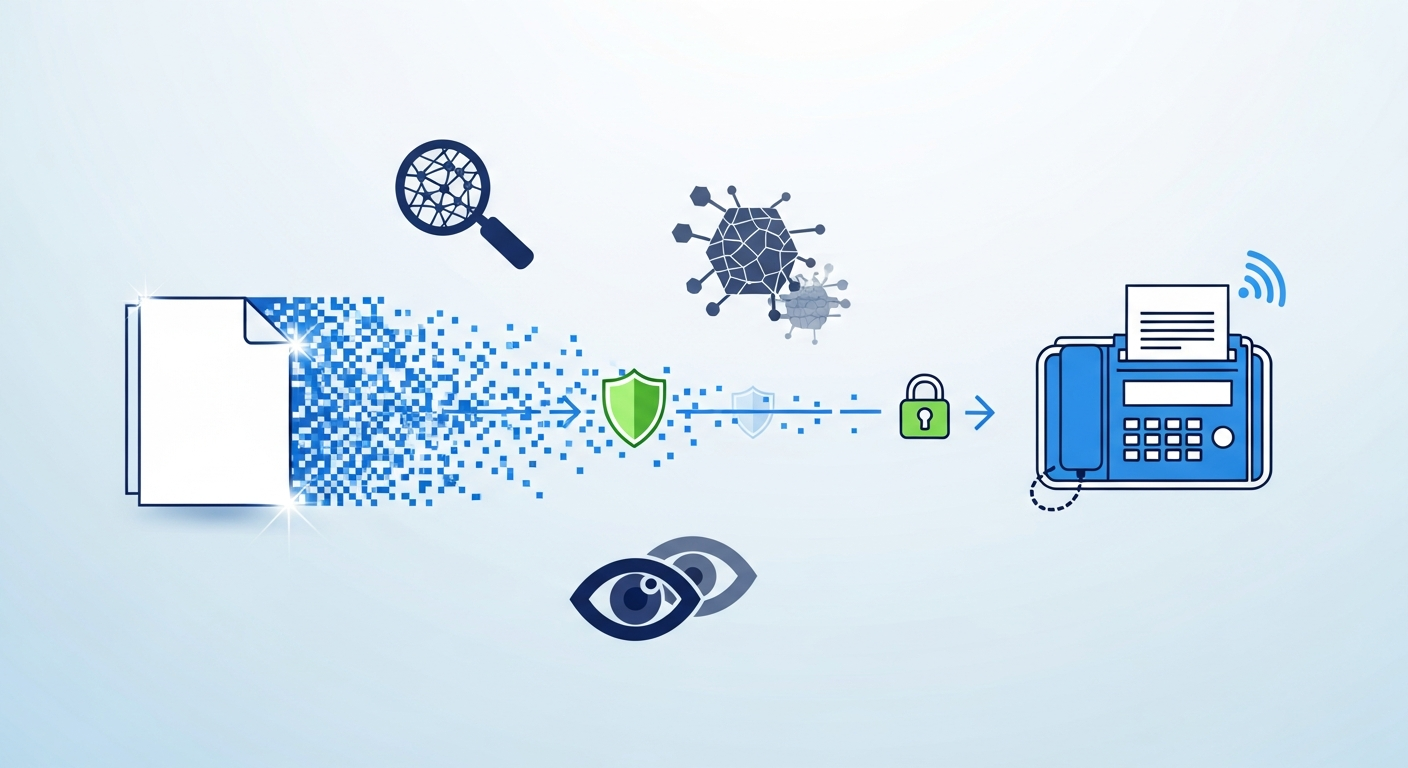
The transition from a physical fax machine, which directly transmits images over a phone line, to an online fax service, which converts documents into digital signals for internet transmission (Fax over IP – FoIP), promised efficiency and convenience. What it often delivered, however, was a subtle but significant erosion of privacy. Analog fax machines, for all their perceived slowness, offered a form of privacy inherent in their physical nature: once a document was sent, the machine retained no digital copy, nor did it require any personal identifier beyond the sender’s number (often just a business line). Online services, by contrast, operate on a different paradigm, one frequently built upon data collection.
The Hidden Cost of “Free” and Subscription-Based Fax Services
The landscape of online fax underwent a seismic shift in the early 2020s. When prominent players like HelloFax eliminated their free tiers in 2020, followed by eFax’s pivot to a subscription-only model in 2022, users were ushered into a new normal: mandatory account creation for even a single, one-time fax transmission. This systemic shift wasn’t primarily driven by a desire to enhance service quality or bolster security (though these were often cited); rather, it marked a strategic pivot towards comprehensive data harvesting and user monetization.
Consider the granular level of personal information you are routinely compelled to provide merely to send one fax through these prevalent services:
- Full Name and Email Address: This is almost universally required, forming the cornerstone of your digital identity within their system.
- Phone Number: Frequently mandated for “verification” purposes, ostensibly to combat spam, but also serving as another potent identifier.
- Credit Card Details: Even for purported “free trials,” payment information is often demanded upfront, creating a financial link to your identity.
- Acceptance of Broad Terms of Service (ToS) and Privacy Policies: These lengthy, often opaque legal documents typically contain clauses that grant the service provider expansive rights to collect, process, and crucially, share your data with an undefined network of “partners” and “affiliates.”
The Core Problem: By undergoing this mandatory registration, you are not simply initiating a fax transmission; you are inadvertently forging a permanent digital identity inextricably linked to potentially highly sensitive document transmissions. That critical medical form you faxed to your insurance provider? The online fax service now possesses your email, your phone number, potentially your billing address, and an indelible record of precisely what document you sent, when you sent it, and to whom. This digital footprint can persist indefinitely, becoming a vulnerability rather than a convenience.
Why This Matters: Unmasking the Real Privacy Risks
The act of creating an account for a one-time fax might seem innocuous, a minor inconvenience. However, when viewed through the lens of modern data practices, it exposes users to a spectrum of significant and often underestimated privacy risks.
1. Perpetual Data Breach Exposure
The digital realm is rife with data breaches, and online fax services are far from immune. In 2023 alone, a major online fax provider reportedly suffered a breach that exposed the records of over 8 million users. This incident didn’t just reveal email addresses; it often included sensitive document metadata, recipient information (names, fax numbers of doctors, lawyers, etc.), and even fragments of document content. Crucially, users who had sent a single fax half a decade earlier suddenly found their healthcare providers, legal contacts, and other personal connections exposed to malicious actors. The data you provide today for a fleeting transaction can become a liability years down the line, sitting in a database waiting for the next cyberattack. Protecting your sensitive information begins with minimizing its collection. Consider a cross-cut paper shredder for physical documents before scanning, adding an extra layer of privacy.
2. Unwanted Marketing and Database Permanence
The fine print of most Terms of Service agreements almost invariably includes clauses permitting the service provider to use your contact information for “communication about our services and partner offers.” That one-time fax, intended as a fleeting interaction, frequently morphs into a lifetime of promotional emails, newsletters, and targeted advertisements. More disturbingly, your meticulously collected contact information is often monetized further through sale or lease to third-party data brokers. These brokers aggregate vast datasets, combining your fax service information with data from countless other sources to construct highly detailed personal profiles, which are then sold to marketers, political campaigns, and even insurance companies. A robust VPN subscription can help mask your online activities and reduce data tracking across various services.
3. GDPR, CCPA, and Global Data Protection Non-Compliance
For users residing in Europe, the practices of many US-based online fax services present a significant challenge regarding the General Data Protection Regulation (GDPR). A cornerstone principle of GDPR is “data minimization,” which strictly mandates that organizations collect only the data that is absolutely necessary for the delivery of a specific service. Requiring full account creation, including extensive personal identifiers, for a one-time fax transmission fundamentally violates this core tenet. Similar principles are enshrined in California’s CCPA (California Consumer Privacy Act) and other emerging global privacy regulations. These laws also grant individuals rights like the “right to be forgotten” (deletion of data) and the right to access their data – rights that become arduous to exercise when data is indiscriminately collected and shared across multiple platforms and partners.
4. Identity Correlation Risk: The Invisible Puzzle
In our interconnected digital lives, we often use the same primary email address, phone number, or even credit card across a multitude of online services. This seemingly convenient practice inadvertently empowers data aggregators to stitch together disparate pieces of information, forming a comprehensive and disturbingly detailed profile of your life. A seemingly innocuous online fax service account can become another crucial data point in this digital puzzle. Data aggregators can link your healthcare faxes with your legal filings, your financial documents, and even your online shopping habits. This level of identity correlation opens doors to highly sophisticated targeted scams, discrimination (e.g., higher insurance premiums based on aggregated health data), and even surveillance, blurring the lines between personal privacy and public exposure.
What the Industry Won’t Tell You: The Business Model of Your Data
The pervasive shift toward mandatory registration for online fax services isn’t a byproduct of enhanced security protocols or user experience improvements. It is, at its heart, a sophisticated strategy centered on customer acquisition cost (CAC) optimization and maximizing lifetime value (LTV) through data monetization. Every “registered user” isn’t just someone sending a fax; they are transformed into:
- A Marketing Email Subscriber: Possessing a measurable lifetime value (often estimated at $10-50 per subscriber) for future marketing campaigns.
- A Potential Upsell Target: For premium tiers, additional features, or bundled services.
- A Rich Data Point: For highly precise advertising retargeting campaigns across the internet.
- An Asset for Acquisition Valuations: A larger registered user base (even if many are inactive after a single fax) significantly inflates a company’s valuation during potential mergers or acquisitions.
Meanwhile, the fundamental, actual technical requirement for successfully sending a digital fax remains elegantly simple: the document itself and the recipient’s fax number. All other mandatory data inputs—email, phone, credit card, detailed personal information—serve primarily as mechanisms for surveillance, marketing, and monetization, rather than essential operational needs. It’s an elaborate form of “surveillance theater” masquerading as necessary service delivery.
The Technical Reality of Online Fax Versus Data Harvesting
To understand why extensive registration is often superfluous, it helps to grasp the technical underpinnings. Analog fax machines transmit documents via modulated audio tones over a traditional telephone line. Online fax services (FoIP – Fax over IP) digitize your document and send it over the internet to a FoIP gateway. This gateway then converts the digital data back into analog fax signals, which are sent to the recipient’s traditional fax machine or another FoIP gateway. Crucially, at no point in this core transmission process is your name, email address, or credit card number inherently required for the data packet to reach its destination. The necessary metadata includes the sender’s identifier (often just a generated number), the recipient’s number, and the document data. The additional PII is layered on top, not out of technical necessity, but out of a business model imperative.
The Privacy-First Alternative: Demanding Data Minimization
The answer to this privacy dilemma isn’t to abandon faxing entirely – a pragmatic impossibility for many given institutional requirements. Instead, the solution lies in a conscious, collective demand for digital tools that scrupulously adhere to the principle of data minimization: collect only what is absolutely essential for service delivery, and retain nothing that is unnecessary, especially sensitive personal data. A secure Yubico Security Key can offer enhanced physical security for your accounts, but it won’t prevent data collection if the service itself is designed to harvest.
Privacy-respecting fax services are not mythical; they exist and operate on fundamentally different ethical frameworks. MyFax.Space, for instance, exemplifies a zero-registration model. Users simply upload their document, input the recipient fax number, and the transmission commences – no account creation, no email address required, and no persistent tracking cookies beyond ephemeral session management essential for the single transaction. This model prioritizes the service itself, decoupling it from the data-extractive business models prevalent elsewhere.
Key Features of a Truly Privacy-First Fax Service:
- No Account Requirement: For standard, one-time transmissions, an account should be entirely optional or non-existent.
- Automatic, Short-Term File Deletion: Documents and associated metadata should be automatically purged from servers within a very short timeframe (e.g., 24-48 hours maximum retention) after successful transmission.
- Zero or Minimal Tracking: Absence of persistent tracking cookies, third-party analytics scripts, and behavioral tracking.
- Explicit GDPR/CCPA Compliance: Clear, concise data handling policies that prioritize user rights and adhere strictly to global privacy regulations.
- Transparent Business Model: A clear explanation of how the service sustains itself without resorting to data monetization (e.g., paid per-fax model without hidden subscriptions).
- End-to-End Encryption (where feasible): While direct fax transmission isn’t fully end-to-end encrypted like modern messaging apps, the digital journey of your document to the FoIP gateway should be secured with robust encryption.
- Open-Source or Auditable Infrastructure: While rare, services that offer some level of transparency or external auditing provide greater confidence in their privacy claims.
Comparison Table: Typical vs. Privacy-First Online Fax Services
| Feature | Typical Online Fax Service | Privacy-First Online Fax Service |
|---|---|---|
| Account Creation | Mandatory for most (even one-time use) | Optional or entirely absent for one-time use |
| Email/Phone Required | Almost always required | Not required for basic transmission |
| Credit Card for ‘Free Trial’ | Often required, with auto-renewal traps | Not required; transparent pricing per fax/usage |
| Data Retention (Documents) | Often stored indefinitely; user must manually delete | Automatic deletion after successful transmission (e.g., 24-48 hrs) |
| Marketing Communications | Opt-out by default; frequent emails and partner offers | Minimal to no marketing; user initiates communication |
| Data Sharing with 3rd Parties | Commonly permitted by ToS, often for marketing/analytics | Rare or explicitly disallowed; data stays within service |
| Tracking Cookies/Analytics | Extensive 3rd-party tracking for profiling | Minimal first-party cookies for session management only |
| Business Model | Subscription, data monetization, upsells | Pay-per-use, transparent pricing, no data sales |
| GDPR/CCPA Compliance Focus | Often minimal adherence, focusing on legal loopholes | Strict adherence to data minimization and user rights |
| Identity Correlation Risk | High; data contributes to comprehensive user profiles | Very low; no persistent identifier to link across services |
What You Can Do Today: Empowering Your Digital Privacy
Taking control of your data footprint doesn’t require a complete overhaul of your digital life; small, conscious choices can make a significant difference.
- Audit Your Digital Footprint: Begin by reviewing which services (not just fax) hold your personal data. Utilize online tools and resources to identify dormant accounts. Under GDPR (for EU residents) and CCPA (for Californians), you have the right to request access to your data and, crucially, demand its deletion. Exercise these rights.
- Embrace Anonymous Email Forwarding: For any service that insists on an email address, but where you suspect data harvesting, leverage privacy-focused email forwarding services like SimpleLogin or Firefox Relay. These services create disposable or alias email addresses that forward to your primary inbox, allowing you to easily cut off unwanted communications or identify data breaches linked to specific services.
- Reject “Free Trials” that Demand Credit Cards: Be acutely wary of any service advertising a “free tier” or “free trial” that immediately demands your credit card details. This tactic is a clear indicator that the provider’s primary objective is payment capture and conversion, not truly offering a risk-free trial of their service. A good password manager can also help generate unique, strong passwords for any necessary registrations, reducing your overall risk.
- Support Privacy-First Tools and Services: Every time you choose a provider whose business model doesn’t rely on data harvesting, you cast a vote for a more ethical and privacy-respecting internet. This applies not just to fax services, but also to browsers, search engines, communication apps, and file-sharing platforms. Seek out transparency and avoid services that are opaque about their data practices.
- Educate Yourself and Others: Share your knowledge. The more users understand these hidden mechanisms of data collection, the greater the collective pressure on companies to adopt more ethical practices.
FAQ: Common Questions About Online Faxing and Privacy
Q: Is online faxing ever truly secure if I can’t encrypt it end-to-end?
A: While traditional fax (and its FoIP digital equivalent) doesn’t offer true end-to-end encryption in the way modern messaging apps do, a privacy-first online fax service can significantly enhance security. Look for services that encrypt your document during its journey over the internet to their FoIP gateway and then delete it quickly. The critical difference is minimizing data retention and collection, which reduces the risk of long-term exposure from breaches or data sharing, even if the final leg of the transmission is unencrypted to a legacy fax machine.
Q: What if my workplace or institution forces me to use a specific online fax provider?
A: If you have no choice but to use a specific provider, focus on minimizing your exposure within that system. Use a unique, disposable email address if possible. Provide only the absolutely required information. Review their privacy policy to understand what data is collected and how long it’s retained, and exercise any rights you have (e.g., to request data deletion) once your task is complete. Advocate within your organization for the adoption of more privacy-respecting tools.
Q: Are there any free online fax services that are truly privacy-respecting?
A: Truly free, privacy-respecting services are exceptionally rare in any domain, as maintaining infrastructure incurs costs. If a service is “free,” its business model almost certainly involves monetizing your data, advertisements, or aggressive upsells. Privacy-first services typically operate on a pay-per-fax or subscription model where the fee covers operational costs, allowing them to avoid data harvesting. Prioritize services with transparent pricing over those promising something “for free.”
Q: How long should an online fax service retain my documents?
A: For privacy, documents should be retained for the absolute minimum time necessary to ensure successful transmission and address any immediate delivery issues. For a single-use fax, this typically means deletion within 24-48 hours. Services that offer longer retention (e.g., for records or future access) should provide this as an opt-in feature, with strong encryption and clear policies about access and deletion, rather than as a default.
Q: Can a physical fax machine offer better privacy than online services?
A: In some respects, yes. A dedicated physical fax machine connected to a private phone line avoids the digital data trails, account requirements, and third-party data sharing inherent in many online services. Once a document is sent, there’s typically no digital record retained by an external service. However, physical faxes still require you to physically safeguard the machine and the received documents, and the transmission itself over traditional phone lines isn’t encrypted. For ultimate control and no third-party involvement, a physical machine (like a simple Brother FAX-575 Personal Fax/Phone/Copier) can be a strong privacy choice for specific needs, though less convenient.
The Bigger Picture: Voting with Your Data Footprint
The issue of mandatory registration for a one-time fax is not an isolated anomaly; it is a microcosm of a much larger, more pervasive problem: the creeping normalization of excessive data collection across virtually every digital service we use. We have, over time, been subtly conditioned to accept a Faustian bargain – that “free” or even “convenient” inherently means “surveilled.” Yet, this trade-off is not a technological necessity; it is a business model choice.
Every time we consciously choose a privacy-respecting alternative, whether it’s for a mundane task like faxing a form or a critical one like secure communication, we are effectively casting a vote with our data footprint. We are sending a clear, unambiguous signal to the tech industry that surveillance-based business models are not universally acceptable, even when they are artfully disguised within sleek user interfaces and marketed as “seamless” user experiences. We, as users, possess significant power in shaping the future of digital privacy.
The next time you find yourself needing to send a fax, pause and reflect: Does this service truly need my email address, my phone number, or my credit card details to perform its stated function, or does it merely *want* them for purposes unrelated to service delivery? The answer, when you interrogate the necessity, might profoundly alter your perception and guide your choices toward a more private digital future.
About the Author: The MyFax.Space team builds privacy-first productivity tools for users who believe convenience shouldn’t require compromising personal data. Learn more at https://myfax.space.